10 Bedside Table Decor Ideas That Look Designer-Approved
Introduction
Your Bedside Table Decor Ideas sees you at your absolute worst — 2 AM water grabs, phone charger chaos, a stack of books you definitely meant to read. And yet somehow, it’s also one of the most photographed spots in any well-designed bedroom. The difference between a bedside table that looks like a dumping ground and one that looks designer-approved comes down to a few intentional choices.
I’ve styled and restyled my own nightstand more times than I’d like to admit. What I’ve learned is that it’s not about spending a lot — it’s about understanding what actually works visually and functionally in that small but mighty space.
Here are 10 bedside table decor ideas that look genuinely designer-approved — and more importantly, still leave room for your midnight snacks.
1. The Classic Lamp and Book Stack Combo
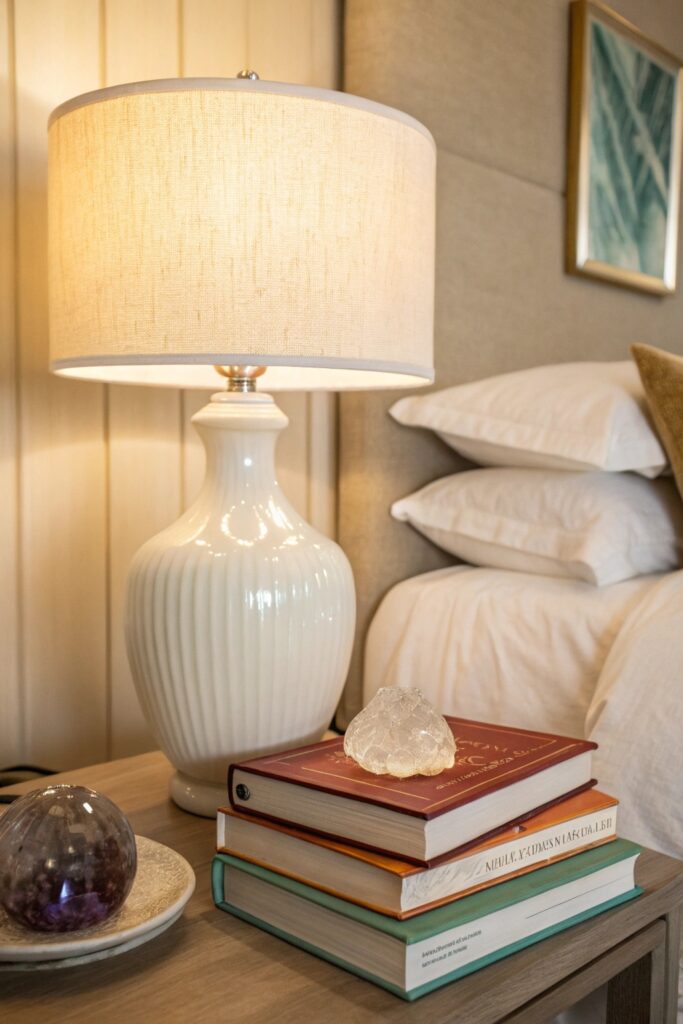
If there’s one bedside table formula that designers return to again and again, it’s the lamp paired with a thoughtfully stacked set of books. It’s simple, it’s functional, and when executed well, it looks effortlessly intentional — the holy grail of bedroom styling.
The lamp does the heavy visual lifting here. Choosing the right lamp scale matters more than almost any other decision for your nightstand — too small, and it looks lost, too large, and it overwhelms everything around it. Your lamp shade bottom should sit roughly at eye level when you’re sitting up in bed, which puts the light exactly where you need it for reading.
What makes this combination look designer-approved:
- Lamp with a sculptural or interesting base — ceramic, stone, brass, or blown glass all elevate the look significantly beyond a basic builder-grade lamp
- Linen or drum shade in white, cream, or a coordinating neutral — these photograph beautifully and age gracefully
- Two to four books stacked horizontally with spines facing outward — color coordinate the spines for a polished look
- One small object on top of the book stack — a crystal, a small figurine, or a decorative stone adds a finishing layer
The book stack acts as a riser for whatever sits on top of it, which is a designer trick worth stealing completely. Instead of everything sitting flat on the table surface at the same height, the stack creates a second level that adds dimension and visual interest to the whole arrangement. Stack your most beautiful books with their spines coordinating with your bedroom color palette, and the effect looks genuinely considered.
2. Minimalist Single Statement Object
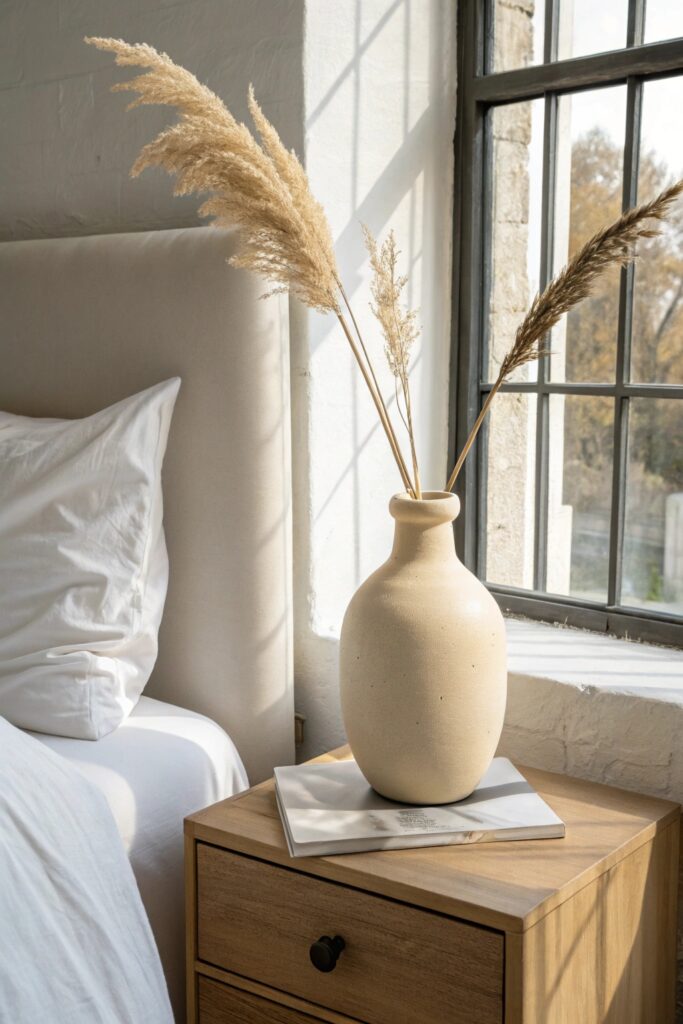
Sometimes the most designer-approved bedside table is also the most restrained one — and the minimalist single statement object approach proves that point every single time. One extraordinary object on an otherwise clear surface creates more visual impact than five mediocre objects competing for attention.
This approach works particularly well in modern, Scandinavian, and contemporary bedroom aesthetics where the philosophy of intentional restraint drives every design decision. But even in more maximalist bedrooms, a nightstand that plays quietly against a busier backdrop provides crucial visual relief.
Objects that work beautifully as a single bedside statement:
- A large sculptural ceramic vase with a single stem, or left beautifully empty
- An architectural table lamp that functions as a sculpture when switched off
- A substantial crystal or stone object — a geode, an alabaster sphere, a chunk of raw quartz
- A beautifully bound single book standing upright like an art object
- A small handmade ceramic bowl holding a single ring or a few collected stones
The single object approach demands that your one chosen piece genuinely earns its place through beauty, scale, or material quality. This isn’t the moment for a random candle or a forgettable trinket — choose something you’d be happy looking at every morning and night, something that brings you a small moment of quiet pleasure every time your eye lands on it. That standard is exactly how designers think about object selection, and it’s a standard worth adopting completely.
3. Fresh or Dried Floral Arrangement

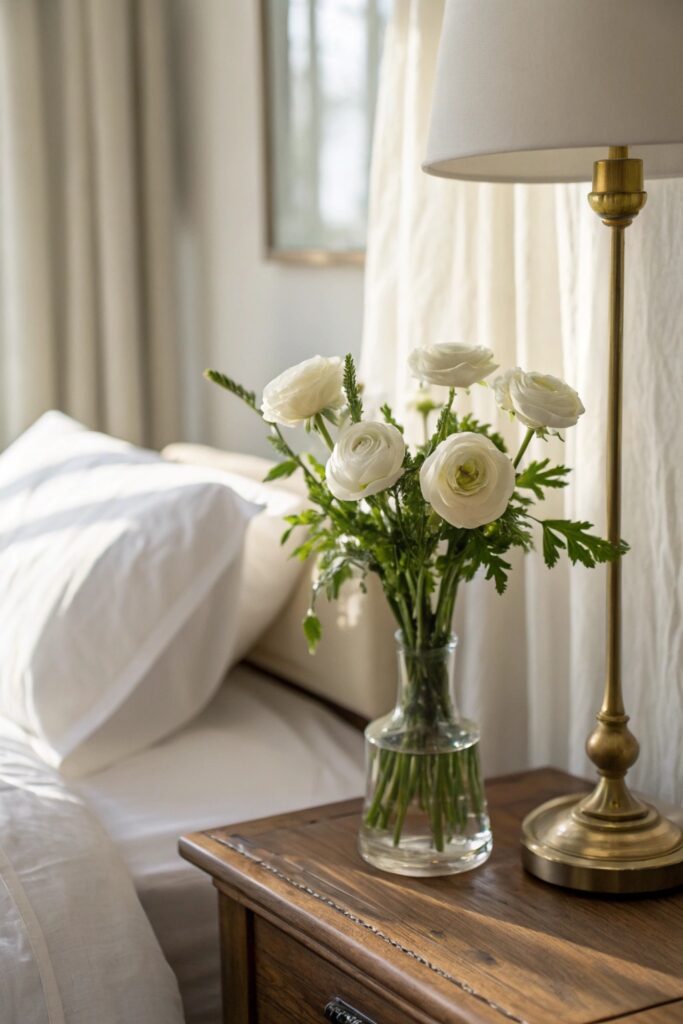
Nothing elevates a bedside table faster or more naturally than fresh flowers or a beautifully arranged dried botanical display. A small vase with even one or two stems creates life, color, and organic texture that no manufactured object can replicate — and it signals the kind of attentive, detail-oriented approach to home styling that makes spaces feel genuinely special.
The choice between fresh and dried florals comes down to lifestyle and aesthetic preference, and both approaches work beautifully in different ways.
Fresh flowers versus dried botanicals — honest comparison:
Fresh flowers:
- Provide unmatched natural beauty and fragrance
- Require weekly replacement and water maintenance
- Work best in bedrooms with good natural light
- Make the strongest visual and sensory impact
- Best for people who enjoy the ritual of changing them regularly
Dried botanicals:
- Last months or years with zero maintenance
- Offer muted, sophisticated tones that photograph beautifully
- Work in any light condition, including low-light bedrooms
- Feel very current with the natural and organic decor trend
- Best for people who want the look without the upkeep commitment
For bedside tables specifically, scale matters enormously with floral arrangements. An oversized arrangement overwhelms a small nightstand surface and blocks your lamp light. A single stem in a bud vase or a small, tight cluster of three to five stems in a low vessel hits the perfect balance — present and beautiful without dominating the entire table. Dried pampas grass, eucalyptus stems, and cotton branches are among the most universally flattering dried options for bedroom nightstands right now.
4. Tray Styling for Instant Organization
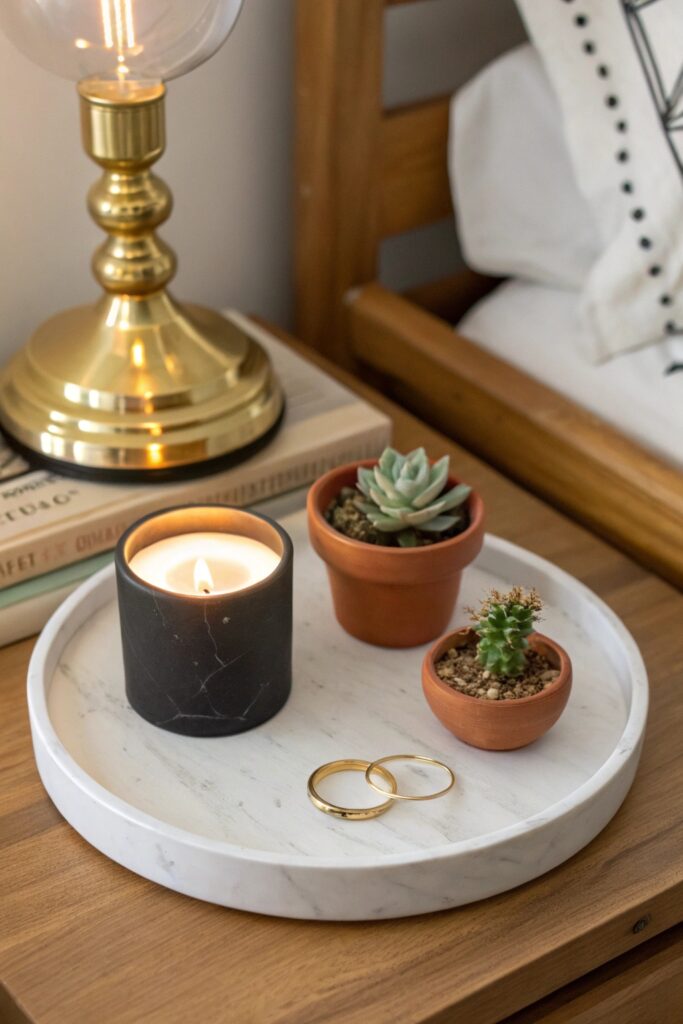
A decorative tray on your bedside table does something almost magical — it transforms a collection of random objects into a curated vignette by simply giving them a defined boundary to live within. This is one of the oldest tricks in the interior design playbook, and it works so consistently because it creates visual order without requiring you to reduce the number of items on your surface.
I started using a small marble tray on my own nightstand, and the difference was immediate and almost embarrassingly significant. Everything that previously looked like clutter suddenly looked intentional just because it sat within a tray boundary. IMO, this single addition delivers more styling impact per dollar than almost anything else on this list.
Choosing the right tray for bedside table styling:
- Marble or stone trays: Luxurious, heavy enough to stay stable, and work with virtually every bedroom aesthetic
- Brass or gold metal trays: Add warmth and a designer-level finish, especially beautiful in warm-toned bedrooms
- Lacquered wood trays: Warm and organic, they work particularly well in natural or Japandi-style bedrooms
- Mirrored trays: Reflect light beautifully, make small surfaces feel larger, add glamour
- Ceramic catchall trays: Perfect for jewelry, rings, and small personal items
Size your tray to take up roughly one third to one half of your nightstand surface — large enough to be meaningful, small enough to leave counter space for practical items outside the tray. What goes inside the tray gets the “styled” treatment; what sits outside can be purely functional. This simple division between styled zone and functional zone is how designers manage bedside tables in real life, and it’s infinitely more sustainable than trying to make every single item look perfect.
5. Candle with Intentional Placement

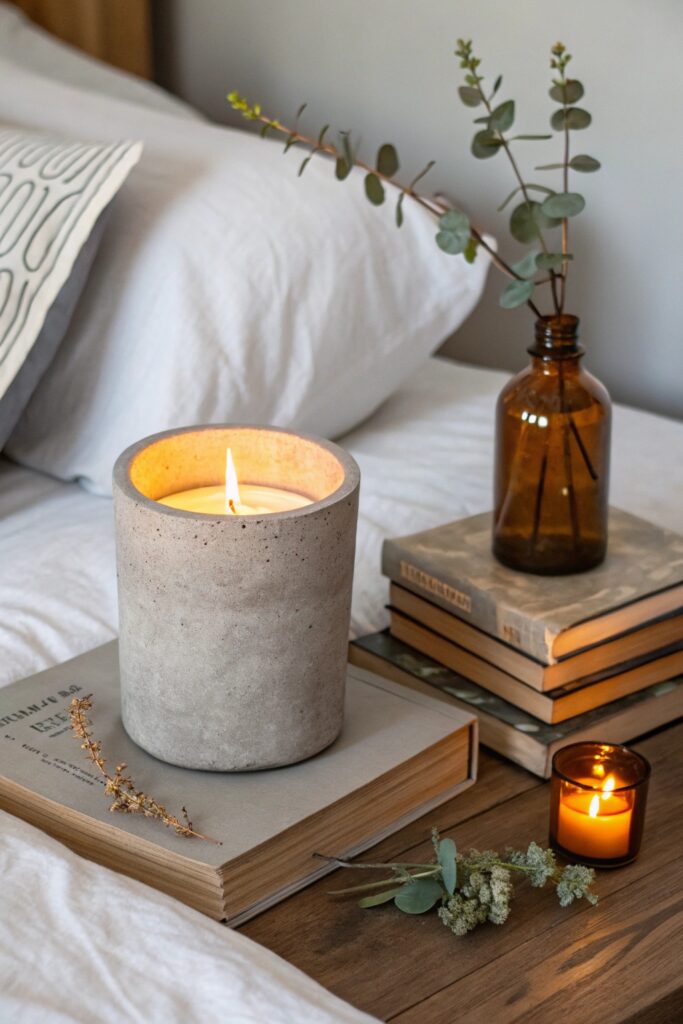
A well-chosen candle on your bedside table accomplishes something no other object quite manages — it adds ambiance, fragrance, visual warmth, and decorative interest all simultaneously. A beautiful candle in the right vessel is doing the work of four separate decorating decisions, which makes it one of the highest-value items you can place on your nightstand.
The keyword in that sentence is beautiful. Not every candle earns a spot on a designer-approved bedside table — the vessel matters as much as the wax inside it.
What separates great bedside candles from mediocre ones:
- Vessel quality: Matte ceramic, concrete, amber glass, and marble vessels look infinitely more elevated than standard glass jars
- Color coordination: The vessel color should connect to your bedroom palette — this sounds obvious, but it’s frequently overlooked
- Appropriate scale: A candle too small disappears on the nightstand; too large and it dominates everything around it
- Scent consideration for bedrooms: Lavender, sandalwood, warm vanilla, and light florals work best — avoid anything too sharp or energizing near your sleep space
- Safety first: Always use a candle snuffer and never sleep with a lit candle
Unlit candles still function as beautiful decorative objects, which makes them one of the most versatile bedside styling tools available. A gorgeous matte black concrete candle on your nightstand looks stunning whether it’s burning or not — that dual function as both active ambiance tool and decorative sculpture is exactly the quality you want from every object in a well-styled space 🙂
6. Stacked Nightstand with Two-Level Styling
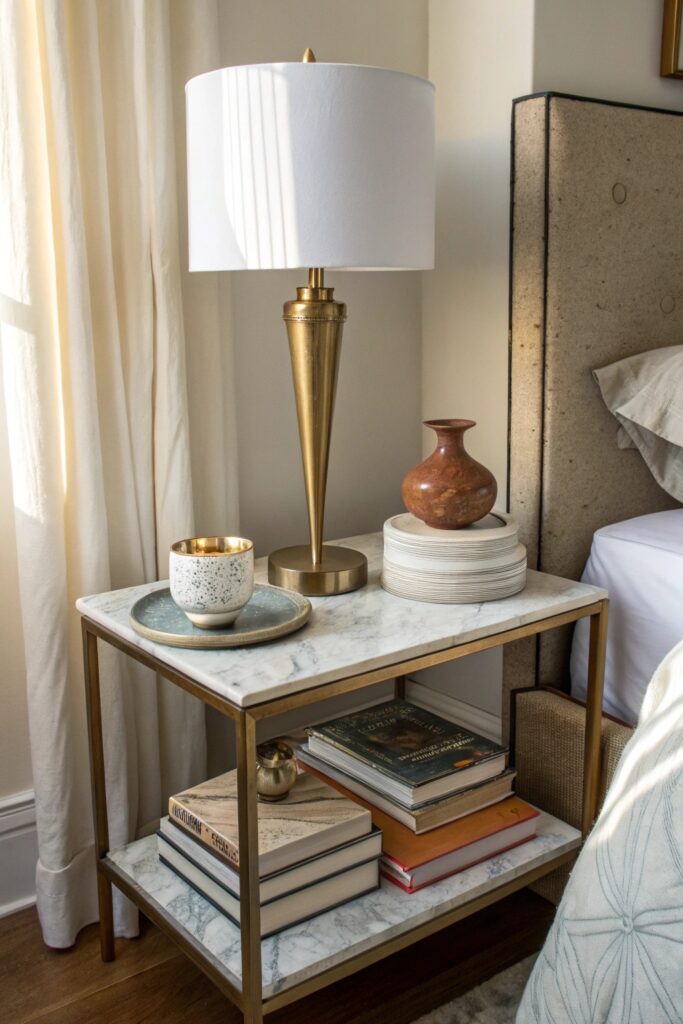
Using two levels on your bedside table — the surface itself and a riser, stack, or small tray elevated above it — creates the kind of dimensional, layered look that makes styled nightstands look professionally designed rather than casually assembled. Flat, single-level styling on a nightstand always reads as unfinished; adding a second level immediately adds depth and sophistication.
This two-level approach mirrors how professional stylists approach every surface — they think in terms of heights and layers rather than just what objects to include.
Creating two-level styling on your nightstand:
- Book stack as riser: Stack two to three hardcover books horizontally and place your lamp or a small object on top
- Wooden or marble riser block: Purpose-made risers in natural materials add an intentional, architectural element
- Small decorative box: A beautiful box on the surface with items arranged both on top of and beside it
- Tray at surface level with a tall lamp above: The height contrast between a flat tray and a tall lamp creates natural two-level interest
- Short candle at surface level beside tall vase: Height variation between objects creates the same layered effect
The rule of thumb for two-level bedside styling is keeping your tallest element — almost always your lamp — on one side and clustering lower objects on the other side or in front of it. This creates a natural triangular composition that the eye finds satisfying and balanced. Triangular arrangements are the foundation of almost all professional surface styling, and they work on bedside tables just as reliably as anywhere else.
7. Personal and Meaningful Object Collection
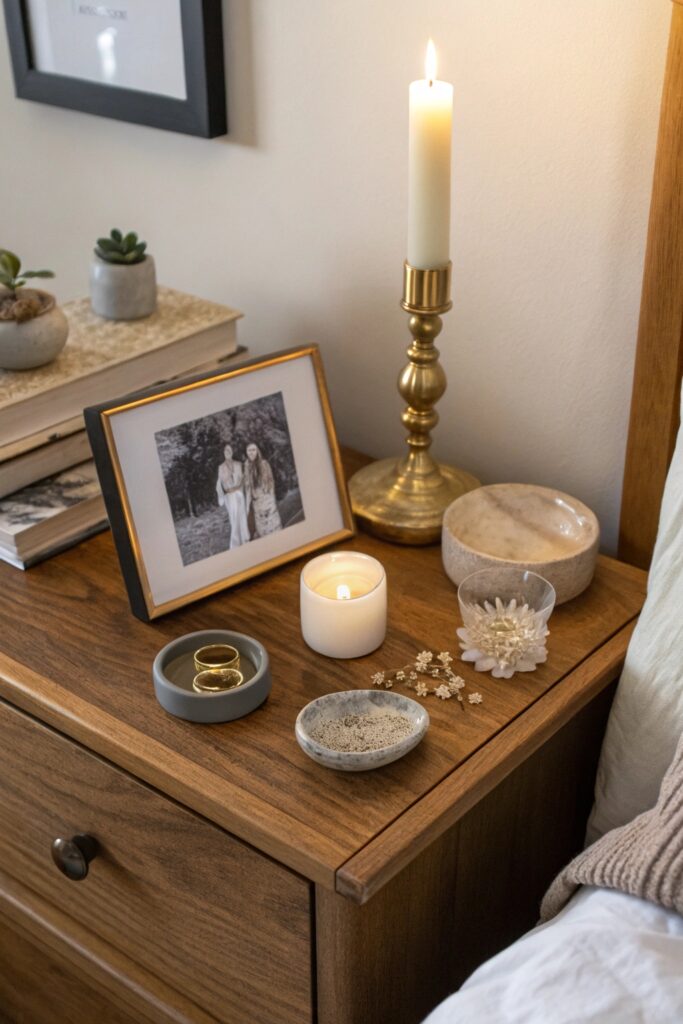
A small collection of personally meaningful objects on your bedside table creates something no purely aesthetic approach can achieve — a space that genuinely reflects who you are and what matters to you. Designer-approved doesn’t have to mean generic luxury; it means intentional, considered, and visually coherent. Your most meaningful possessions can meet all three criteria beautifully.
The bedside table is actually the most personal surface in your entire home — it’s the last thing you see before sleeping and the first thing you see when you wake up. That location deserves objects with genuine meaning rather than objects chosen purely for looks.
What makes a personal collection look styled rather than cluttered:
- Limit to three to five objects maximum — restraint transforms a collection from clutter to curation
- Coordinate loosely by color or material — your grandmother’s ring dish and a collected stone both work if they share a warm metallic or earthy tone
- Vary heights within the collection — even meaningful objects need to follow the basic rules of visual composition
- Group in odd numbers — three objects always look more intentional than two or four
- Give each object breathing room — objects touching each other look crowded; slight spacing makes each piece visible and valued
The story behind your objects is invisible to visitors but completely present to you — and that invisible layer of meaning is what makes a styled space feel genuinely inhabited rather than staged. A small travel souvenir, a crystal someone gifted you, a photograph in a beautiful frame — these personal anchors make your bedroom feel like yours in a way that no purely decorative object ever could.
8. Bedside Water Carafe Setup

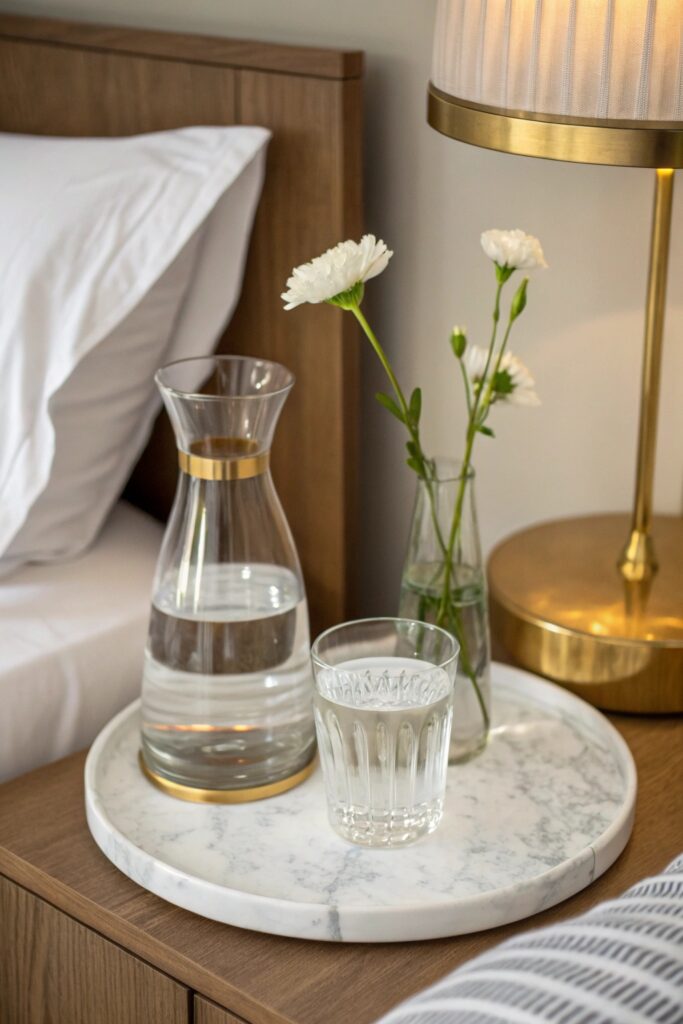
A bedside water carafe and glass set is the most underrated upgrade you can make to your nightstand — and it’s one of those rare items that makes your space look more designer-approved while also solving a practical problem you’ve been ignoring. Reaching for a plastic water bottle in the dark at 2 AM is objectively less elegant than pouring water from a beautiful glass carafe. Small upgrade, significant lifestyle improvement.
The carafe setup transforms a functional necessity into a genuine styling moment, and the best versions look beautiful sitting on your nightstand, whether you’re actively using them or not.
What to look for in a bedside carafe set:
- Clear glass construction: Shows the water clearly, looks clean and refreshing, coordinates with any bedroom aesthetic
- Matching glass that inverts over the carafe top: The classic setup where the drinking glass doubles as a lid — this is both beautiful and practical
- Appropriate capacity: 500ml to 750ml is ideal for overnight — large enough to last, small enough to look proportional on a nightstand
- Simple, clean silhouette: Ornate carafes can look fussy on a nightstand; a clean, simple form photographs better and ages better
- Optional tray underneath: A small stone or glass tray under the carafe set completes the vignette perfectly
Bedside carafes work best positioned on the opposite side of your lamp to balance the visual weight of the nightstand surface. The lamp provides height on one side; the carafe and glass provide a different kind of height relationship on the other. This simple balance is the foundation of nightstand symmetry, even in asymmetrical styling approaches.
9. Artwork or Print Leaned Against the Wall
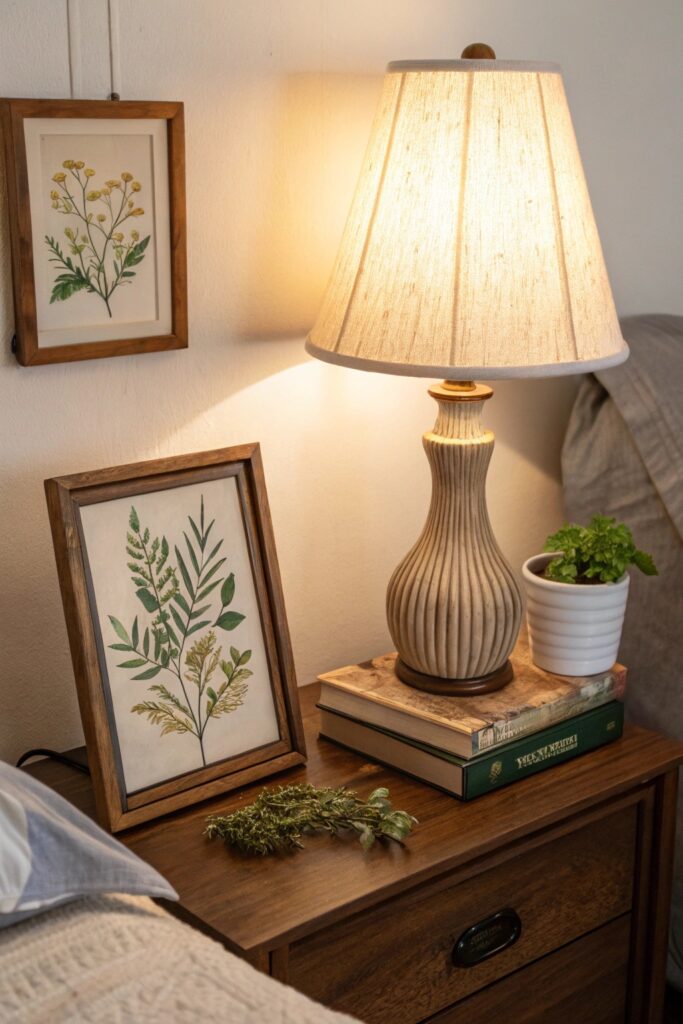
Leaning a small framed print or artwork against the wall behind your nightstand is one of the most effortlessly designer-approved bedside styling tricks available — and it costs almost nothing to implement if you already own art. The leaned art look signals casual confidence and artistic sensibility in a way that perfectly hung, centered artwork never quite achieves.
The lean technique works because it looks intentional without looking rigid. It suggests that the art piece arrived because you love it, not because you measured the wall space and hung it according to a formula. That distinction between curated and decorated is exactly what separates designer-approved spaces from merely decorated ones.
Making lean bedside artwork beautifully:
- Frame size: Medium frames — roughly 8×10 to 11×14 — work best leaned on a nightstand; anything smaller disappears, anything larger overwhelms
- Frame material: Simple wood, black metal, or brass frames all read beautifully leaned against a wall
- Art content: Botanical prints, abstract art, simple line drawings, and photography all work — choose something that contributes to your bedroom’s overall color story
- Layering option: Lean two pieces of slightly different sizes against each other for a more collected, gallery feel
- Stability: Make sure your leaned art sits securely — use a small piece of museum putty or tack behind the frame if needed
The art piece you choose to lean against your bedside becomes something you look at every single day in the quiet moments of morning and evening. FYI — this makes it one of the most impactful art placement decisions in your entire home, because frequency of viewing creates emotional connection in a way that art in a hallway or formal room never quite does.
10. Curated Nightstand with Coordinated Metallic Accents
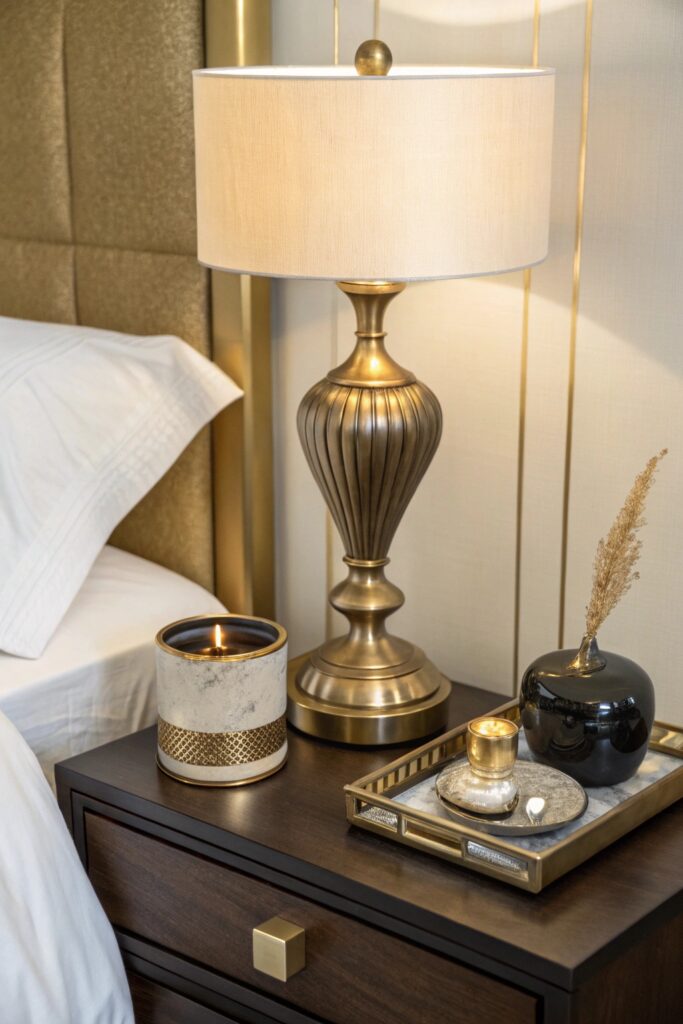
Coordinating your metallic accents across every object on your bedside table is the finishing detail that takes a nicely styled nightstand to a genuinely designer-approved one. When your lamp base, your tray, your candle lid, your carafe cap, and your small decorative objects all speak the same metallic language — all brass, all matte black, all brushed nickel — the whole surface achieves a cohesion that looks professionally considered.
This is the detail that most people miss when they wonder why their nightstand doesn’t quite look as polished as the ones they see in design magazines. The individual objects might be beautiful, but mismatched metals create a subtle visual noise that prevents the whole from looking finished.
The major metallic directions for bedside table styling and what they work best with:
- Brushed brass or gold: Warm, luxurious, works beautifully with cream, blush, terracotta, and deep jewel tones — the most popular choice for designer bedroom looks right now
- Matte black: Graphic, modern, and sophisticated — works brilliantly with white, grey, natural linen, and bold colors
- Brushed nickel or silver: Cool and clean, works best with blue, grey, white, and contemporary minimalist bedroom aesthetics
- Antique bronze: Warm and storied, it works beautifully in traditional, eclectic, and maximalist bedrooms
- Mixed warm metals (brass plus copper): The only successful metal mixing combination — warm metals from the same family can coexist beautifully
You don’t need to buy all new objects to coordinate your metals — this is an editing exercise as much as a shopping one. Remove the pieces that break your chosen metallic direction, and suddenly the remaining pieces look significantly more intentional together. Sometimes the most impactful styling decision is what you take away rather than what you add.
Conclusion
A designer-approved bedside table isn’t about perfection or spending a lot of money — it’s about making intentional choices with scale, height, material, and coordination that make the whole surface feel considered rather than accidental. Every idea on this list works because it applies genuine design thinking to a small but highly visible space.
Start with one change — a great lamp, a marble tray, a single meaningful object given proper breathing room. Notice how that one shift changes how the whole table reads, then build from there.
Your bedside table deserves the same care you give every other surface you style. After all, it’s the first and last thing you see every single day — it might as well look exactly the way you want it to 🙂