10 Small Entryway Ideas That Maximize Every Inch of Space
Introduction
A small entryway is either one of the most frustrating spaces in a home or one of the most satisfying design challenges you’ll ever tackle — and the difference between those two experiences comes down entirely to how you approach it. Most people look at a tiny entryway and see limitations. Smart decorators look at the same space and see a very focused opportunity.
I’ve worked with entryways so small they barely qualify as a room — more of a spatial suggestion, really. What I’ve learned is that small entryways reward clever thinking more than any other space in the home. The right storage, the right scale, and the right visual tricks can make a 4-foot hallway feel genuinely welcoming and surprisingly functional.
Here are 10 small entryway ideas that squeeze every possible inch of function and style out of even the most space-challenged front hallway.
1. Install a Slim Console Table

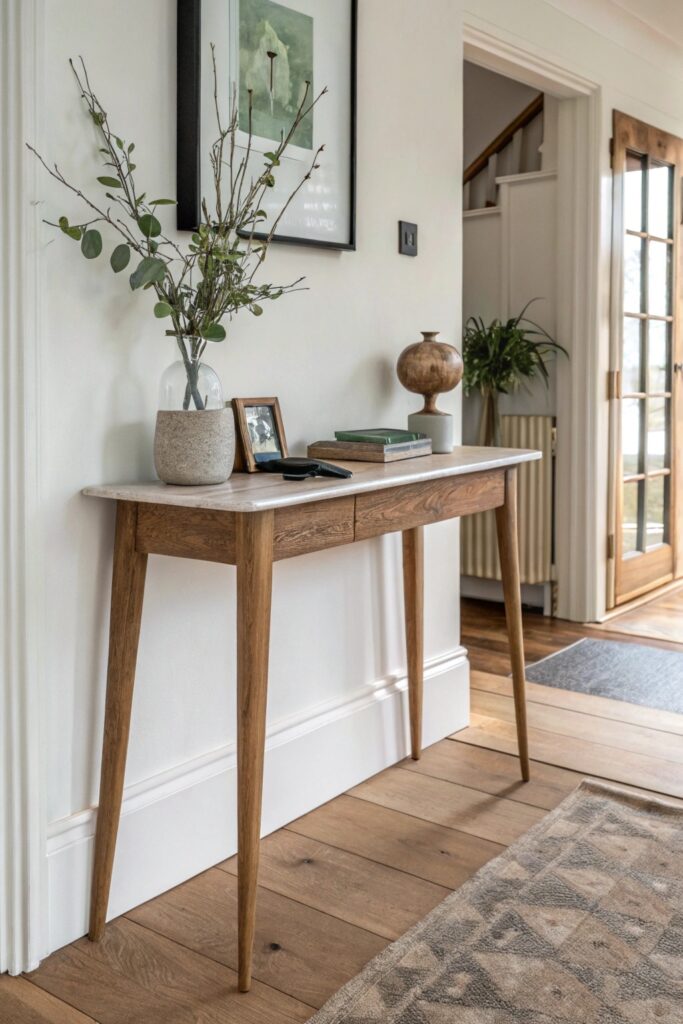
The slim console table is the small entryway’s best friend — and I mean genuinely slim, not just “narrower than a dining table.” We’re talking 10 to 14 inches deep, which is narrow enough to leave comfortable walking clearance in a tight hallway while still providing a surface for keys, mail, and decorative styling that makes the space feel intentional rather than neglected.
The console table transforms a blank wall into a functional moment without consuming meaningful floor space, which in a small entryway is the most valuable real estate you own.
What to look for in a small entryway console table:
- Depth: 10 to 14 inches maximum — anything deeper starts eating into your walking space uncomfortably
- Leg style: Open legs with visible floor beneath create the illusion of more space than solid-based tables
- Height: Standard console height of 28 to 32 inches works for most entryway styling and proportion needs
- Material: Light wood tones, white, and natural finishes make small spaces feel larger; dark finishes work only with excellent lighting
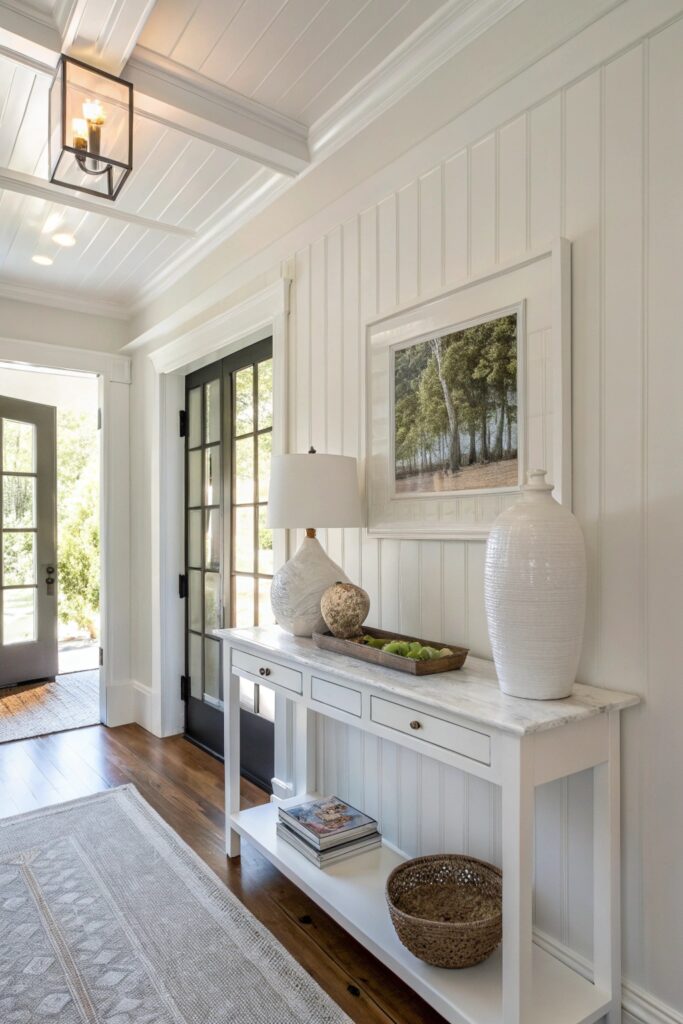
- Under-table storage potential: A table with a lower shelf doubles your storage capacity without adding any extra footprint
The visual trick that makes a slim console table work in a truly tiny entryway is choosing one with legs rather than a solid base. When you can see the floor running continuously beneath the table, your brain reads the floor as larger than it actually is. A solid-based console table in the same space creates a visual barrier that makes the floor — and therefore the room — feel smaller and more cramped.
2. Use Vertical Wall Space with Hooks and Shelves
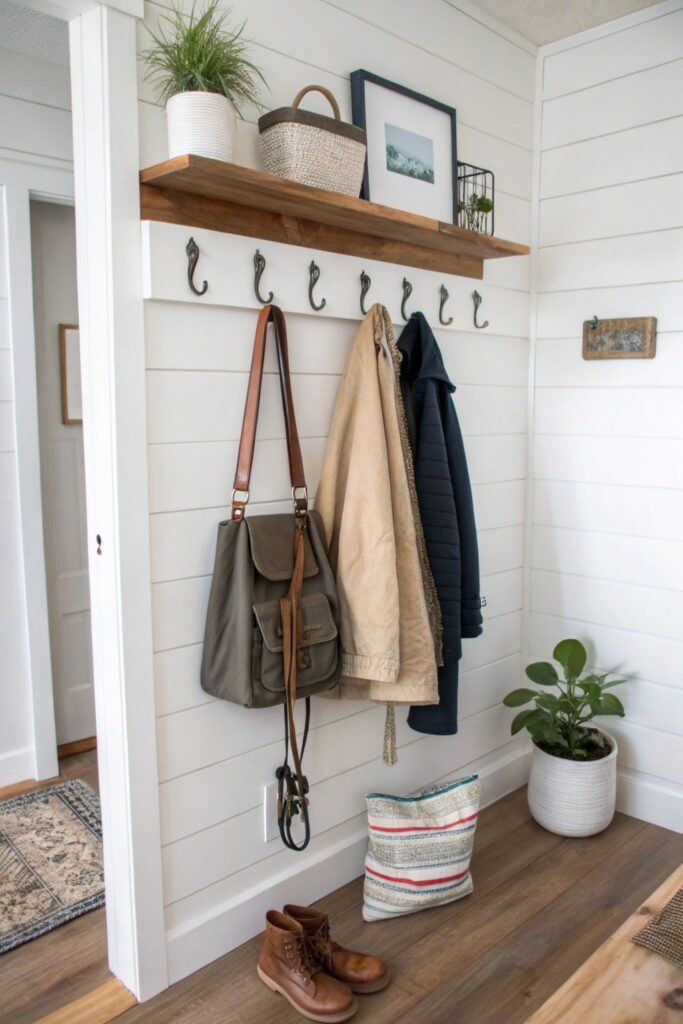
When your floor space runs out — which in a small entryway happens almost immediately — your walls become the solution. Going vertical with hooks, shelves, and wall-mounted storage systems turns what would otherwise be dead wall space into the most functional storage zone in your entryway, and it does it without consuming a single square inch of floor.
This is the strategy that separates small entryways that work from small entryways that feel permanently overwhelmed by the stuff that needs to live near the front door.
Vertical wall storage solutions for small entryways:
- Wall-mounted hook rail: A simple rail with multiple hooks handles coats, bags, umbrellas, and dog leashes all in one organized strip
- Floating shelf above the hook rail: Adds a surface for keys, mail, and decorative items directly above your hanging storage
- Pegboard panel: Infinitely customizable, can hold hooks, small shelves, and baskets in whatever configuration works best
- Built-in cubby system: More investment but maximum organization — dedicated spaces for each family member’s items
- Over-door organizer: Uses the back of your front door for additional storage without touching the walls at all
The most efficient small entryway wall storage systems combine hooks at one height with a shelf above — this creates a dedicated hanging zone below and a surface zone above that together handle the majority of daily entryway needs. Mount your hook rail at approximately 60 to 66 inches from the floor for adult coat hanging, with the shelf sitting 8 to 12 inches above the highest hook.
3. Choose a Mirror to Visually Expand the Space
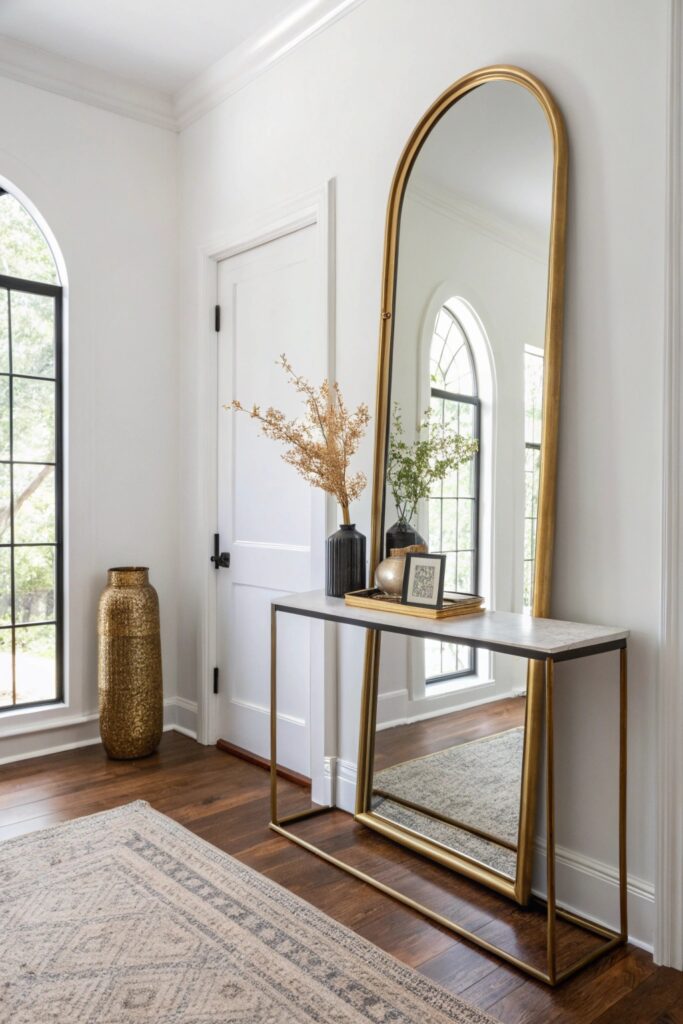
A well-placed mirror is the oldest trick in the small space design playbook — and it earns its legendary status because it genuinely works every single time. A mirror in a small entryway bounces light, creates the visual impression of depth that doesn’t physically exist, and makes a cramped hallway feel significantly more spacious than its actual dimensions suggest.
The mirror also serves the highly practical function of letting you check your appearance before leaving the house, which makes it simultaneously the most useful and most decorative element in your small entryway toolkit.
Mirror strategies that maximize small entryway space:
- Full-length mirror on a narrow wall: Creates the most dramatic space-expanding effect, especially in hallway-style entryways
- Large round mirror above a console table: The circular frame softens the angular geometry of a tight space
- Mirror tiles or mirrored panel: Covers a larger wall area for maximum light reflection in very dark entryways
- Leaned mirror: Avoids wall mounting commitment and looks effortlessly casual — prop against the wall rather than hanging
- Mirror with built-in hooks: Combines the space-expanding mirror function with practical coat storage in one wall-mounted piece
Position your mirror directly opposite your light source — whether that’s a window, an overhead light, or a table lamp. When a mirror faces a light source, it doubles the perceived brightness of the space and creates the most effective visual expansion. A mirror positioned on a dark wall without a light source to reflect provides significantly less impact than one that actively bounces light around the room. IMO, this positioning detail makes the single biggest difference between a mirror that transforms a small entryway and one that simply sits there.
4. Add a Narrow Bench with Under-Seat Storage
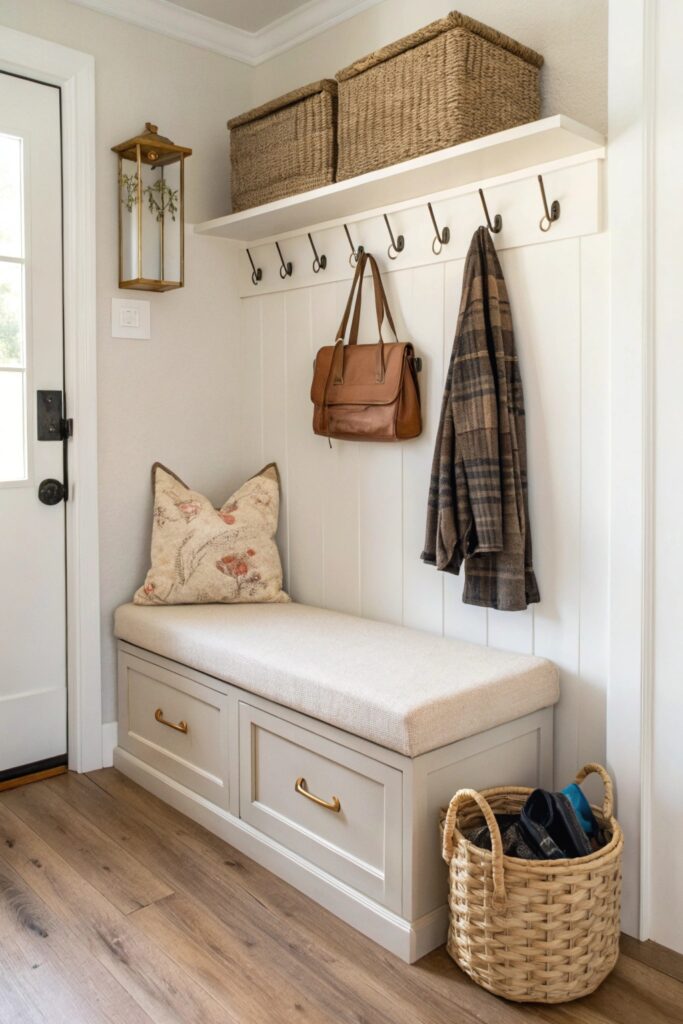
A narrow storage bench in a small entryway solves two problems that consistently plague tight entry spaces — nowhere to sit while putting on shoes, and no storage for the shoes themselves. A bench with a hinged lid or open cubbies underneath transforms your entryway into a genuinely functional transition zone without requiring much more floor space than a console table.
The bench also adds a layer of comfort and hospitality to your entryway that purely decorative elements can’t provide — it tells guests that your home thinks about their practical needs, not just how everything looks.
Choosing the right storage bench for a small entryway:
- Dimensions: Keep the bench under 36 inches long and 14 to 16 inches deep for tight spaces
- Hinged lid storage: The most space-efficient option — lift the seat to access storage for shoes, scarves, and seasonal accessories
- Open cubby base: Easier daily access than a hinged lid, works beautifully for shoes you use regularly
- Upholstered seat: Adds comfort and a decorative textile element that warms up the entryway
- Backless design: Backless benches feel less visually bulky in small spaces than those with backs or arms
Positioning a storage bench along one wall rather than centered in the entryway keeps the traffic flow clear while maximizing the bench’s storage function. Pair it with wall-mounted hooks directly above for a complete coat-and-shoe station that handles the full daily routine — hang your coat above, store your shoes below, sit in the middle to make the swap. This vertical stacking of functions is exactly how small entryways achieve big functionality.
5. Go Light with Your Color Palette

Color choice in a small entryway has more impact on how spacious the space feels than almost any furniture or storage decision you make. Dark colors absorb light and visually advance toward you, making walls feel closer and ceilings feel lower. Light colors reflect light and visually recede, creating the impression of more space than actually exists.
This isn’t just design theory — it’s a practical tool that works immediately and costs only the price of a can of paint. The right color choice in a small entryway genuinely changes how the space feels to walk into.
Color strategies for making small entryways feel larger:
- Crisp white: The classic choice — maximizes light reflection and makes every other element in the space pop
- Soft cream or warm off-white: Warmer than pure white, creates a welcoming rather than clinical feeling
- Very light grey: Sophisticated and versatile, works well with both warm and cool accent tones
- Pale sage or soft mint: Adds gentle color personality while still reflecting light effectively
- Painting the ceiling the same color as the walls: Eliminates the visual boundary between the wall and ceiling, making the space feel taller
The ceiling height trick deserves special attention for small entryways — painting your ceiling the same color as your walls removes the horizontal line that caps your space visually. When the eye can’t find where the wall ends, and the ceiling begins, the room reads as taller and more expansive. This single paint decision costs nothing extra and produces a surprisingly dramatic spatial improvement in low-ceilinged entryways.
6. Install Floating Shelves Instead of Bulky Furniture
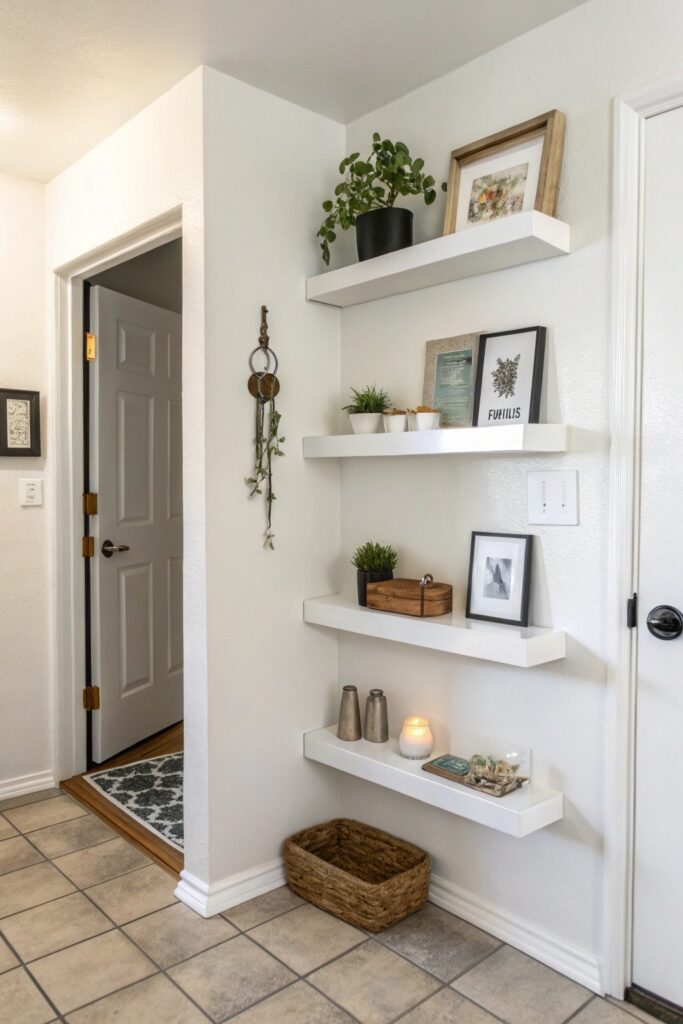
Floating shelves give small entryways the storage and display function of furniture without consuming any floor space whatsoever, which in a genuinely tight entryway is a trade-off worth making enthusiastically. A pair of well-placed floating shelves can handle keys, mail, small plants, decorative objects, and everyday essentials while leaving your entire floor completely clear.
The clear floor is the visual key — even a small entryway feels significantly more spacious when the floor runs uninterrupted from the front door to the rest of the home.
Making floating shelves work in small entryways:
- Install at varying heights for visual interest rather than two shelves at the same level
- Keep shelf depth shallow — 8 to 10 inches handles most entryway storage needs without protruding significantly into the space
- Style the top shelf decoratively and use the lower shelf functionally for daily-use items
- Add a small hook or two under the lower shelf for keys or a small bag — this vertical extension adds function without adding visual bulk
- Choose a shelf color matching your wall color for a built-in, seamless look that makes the shelves recede into the wall rather than standing out
The most effective floating shelf configurations for small entryways use an asymmetric arrangement — one longer shelf positioned higher and one shorter shelf positioned lower on the same wall. This asymmetry creates visual interest that makes a small entryway feel more designed rather than just functionally adequate, and it provides two distinct zones for different types of items.
7. Use the Back of the Front Door

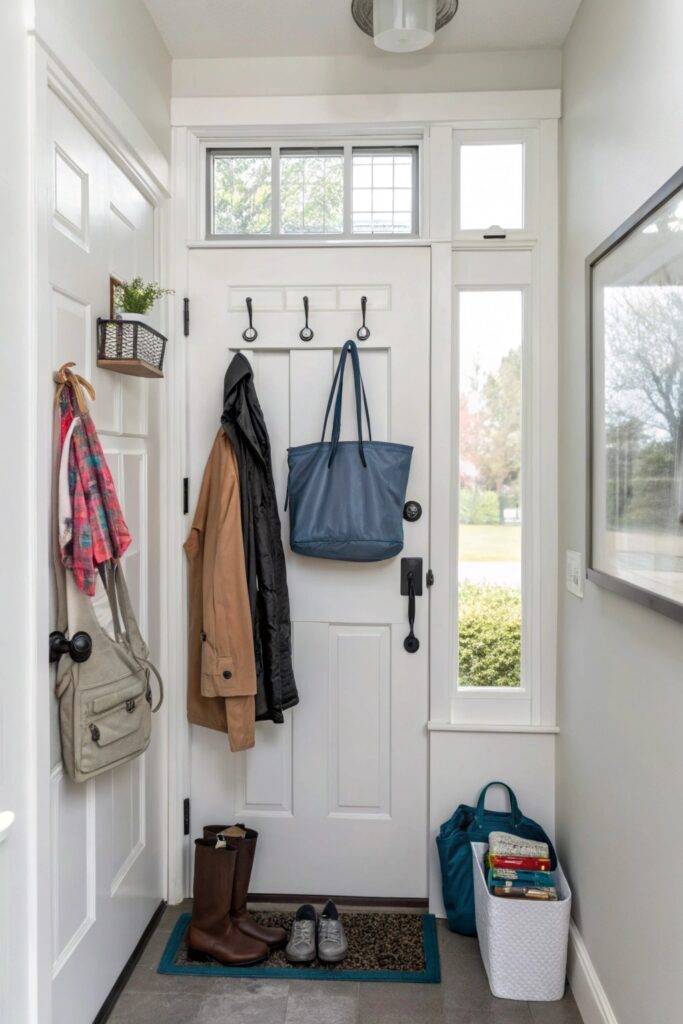
The back of your front door is one of the most consistently overlooked storage opportunities in any home — and in a small entryway where every surface and wall counts, ignoring it is genuinely leaving useful space on the table. An over-door organizer, a mounted hook rail, or a hanging storage system on the back of your front door adds meaningful storage capacity without touching a single wall or consuming any floor space.
The back-of-door zone works especially well for items that need to be accessible exactly when you’re entering or leaving — umbrellas, reusable bags, dog leashes, keys, and lightweight jackets all make perfect back-of-door storage candidates.
Over-door storage solutions for small entryways:
- Over-door hook rack: Simple, effective, handles multiple coats or bags without any installation
- Over-door organizer with pockets: Stores smaller items like gloves, sunglasses, masks, and mail in organized pockets
- Mounted hook rail on door surface: More permanent than over-door options, handles heavier items securely
- Over-door mirror with hooks: Combines the space-expanding mirror function with back-of-door hook storage
- Hanging shoe organizer: Repurposed for entryway items rather than shoes — perfect for small accessories
The key limitation of back-of-door storage is door clearance — you need enough space for whatever you mount to clear the door frame, floor, and any nearby furniture when the door swings open. Measure your clearance carefully before choosing over-door organizers, particularly for deeper options. A storage solution that prevents your front door from opening fully is somehow worse than no storage solution at all :/
8. Bring in a Statement Rug for Definition
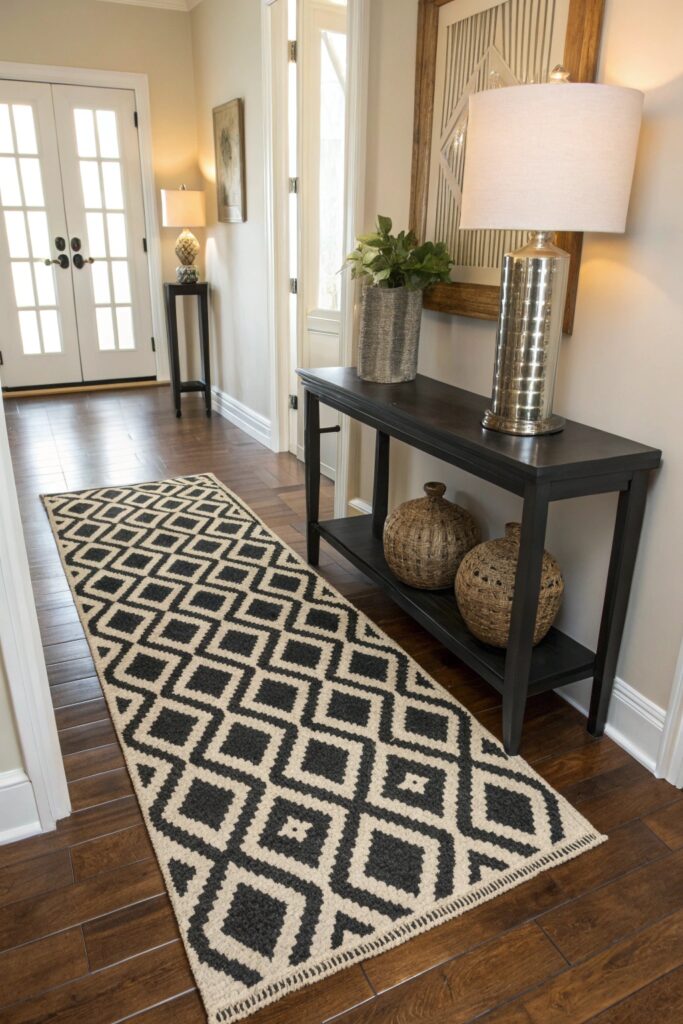
A statement rug in a small entryway does something surprisingly powerful — it defines the entryway as its own distinct zone even when it shares open space with an adjacent hallway or living area. In apartments and open-plan homes, especially, the lack of a rug in the entry area makes the space feel like it doesn’t really exist as its own room. The right rug fixes that instantly.
Beyond zone definition, a rug in a small entryway adds color, pattern, warmth, and texture that makes the space feel finished and welcoming rather than transitional and neglected.
Choosing the right rug for a small entryway:
- Size: Go as large as your space allows — a rug too small looks like a bath mat that wandered in from the bathroom
- Pattern: Bold patterns on small rugs work well because the scale of the space means you see the whole pattern at once
- Material: Flatweave, low-pile, and indoor-outdoor rugs handle the heavy traffic and dirt of an entryway better than plush pile options
- Shape: Runner rugs work perfectly in hallway-style entryways; square or rectangular rugs suit square entry zones better
- Dark colors or busy patterns: Hide dirt significantly better than light solids — a practical consideration for the highest-traffic spot in your home
The rug you choose for your small entryway sets the aesthetic tone for your entire home more than any other single decorating decision in the space. It’s the first thing guests see and stand on, which makes it simultaneously the most noticed and most used element in your entry. Choose something that genuinely represents your home’s personality rather than defaulting to the safest, most generic option available.
9. Maximize with Multi-Functional Furniture
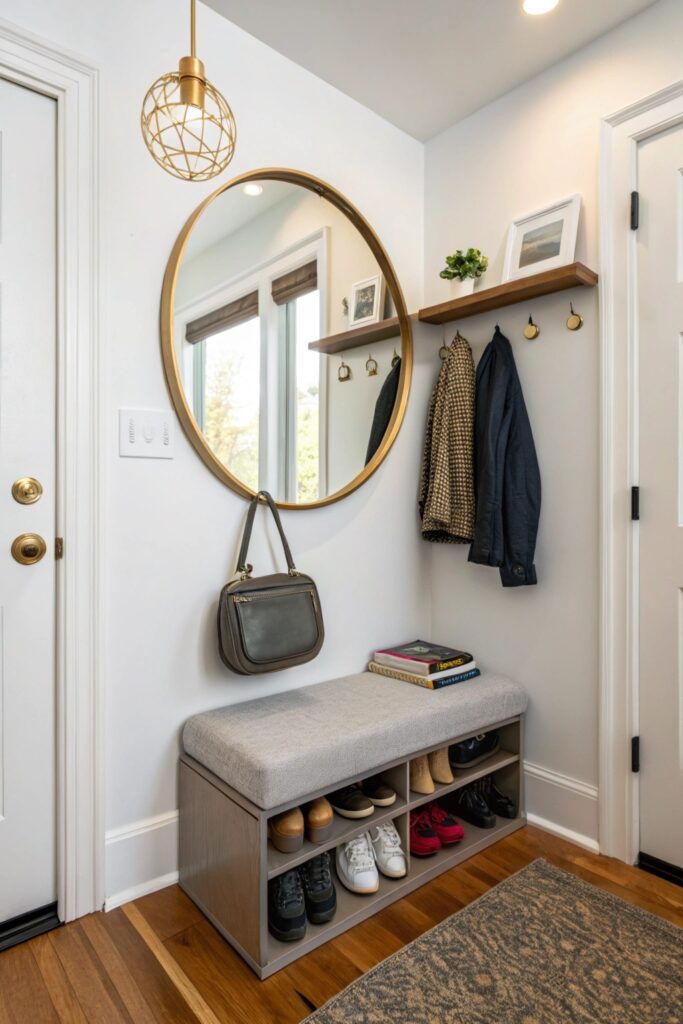
Multi-functional furniture is the small entryway superpower that lets you achieve the storage and function of several separate pieces in the footprint of just one. When square footage is genuinely limited, every piece of furniture needs to justify its presence by serving more than a single purpose — and the best small entryway furniture pieces earn their spot by doing three or four jobs simultaneously.
This isn’t a compromise or a budget consideration — it’s genuinely superior design thinking for constrained spaces.
The best multi-functional entryway furniture pieces:
- Storage bench with hooks above: Sit-store-hang station in one vertical zone — handles shoes, coats, and sitting simultaneously
- Mirror with built-in shelf and hooks: Space expansion, surface storage plus hanging storage in one wall-mounted unit
- Console table with drawers and lower shelf: Surface styling plus concealed storage plus open display in one piece
- Wall-mounted fold-down desk: Functions as an entryway table when folded down, disappears completely when folded up
- Ottoman with storage interior: Seating plus hidden storage in a soft, movable piece that doubles as occasional extra seating for guests
The fold-down wall-mounted desk deserves special mention for truly micro entryways — spaces so small that even a slim console table feels like too much. A fold-down unit mounts flush to the wall and provides a surface when you need it, then folds completely flat when you don’t. In an entryway measured in inches rather than feet, that ability to disappear is genuinely transformative.
10. Light It Well with Layered Sources
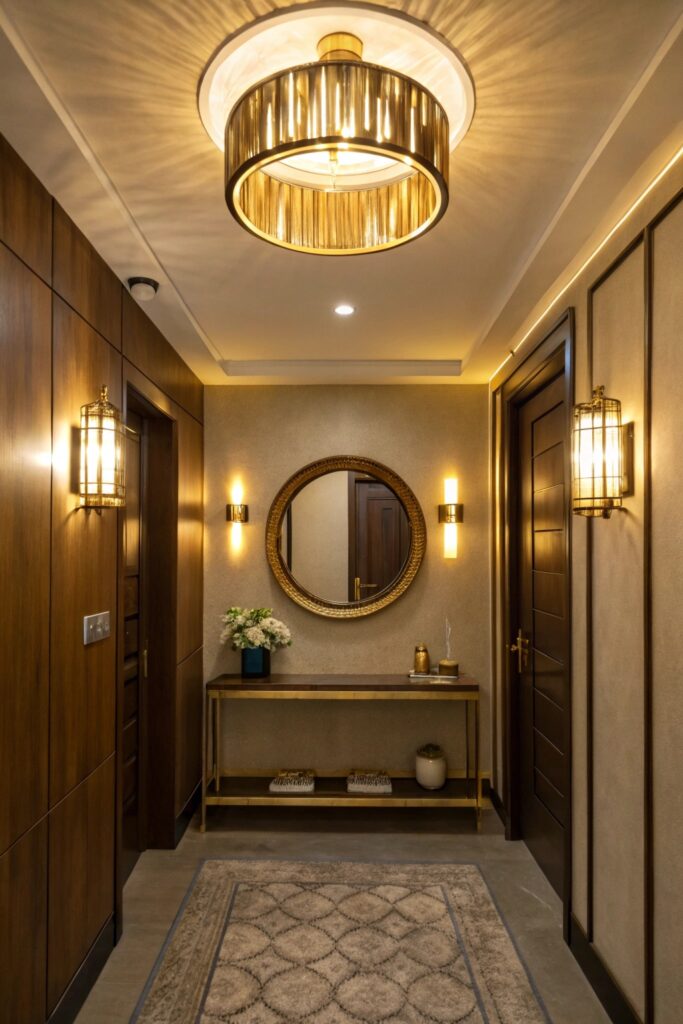
Lighting a small entryway properly is the finishing detail that determines whether all your clever storage and styling decisions look their absolute best or fall flat in a dim, shadowy space. Small entryways often suffer from poor natural light — they’re typically interior spaces without windows, relying entirely on artificial lighting to create atmosphere and visibility.
Getting your lighting right in a small entryway costs very little and makes an immediate, dramatic difference in how welcoming and spacious the space feels.
Layered lighting strategies for small entryways:
- Overhead fixture upgrade: Replace a builder-grade ceiling light with something with genuine visual personality — a small chandelier, a sculptural pendant, or a flush mount with interesting design
- Wall sconces: Mount on either side of your mirror or above your console table for warm, flattering light at eye level
- Table lamp on console table: If your console table is large enough, a small lamp adds warm ambient light and a decorative element simultaneously
- Under-shelf LED strips: Install along the underside of floating shelves for subtle accent lighting that makes the shelf styling glow
- Smart bulbs with warm temperature: Set all your entryway lights to 2700K warm white for the most welcoming golden atmosphere
The single most impactful lighting upgrade for a dark, small entryway is replacing a standard ceiling fixture with something visually interesting. FYI — your overhead fixture is at eye level when you enter the door and look up, which makes it one of the most noticed elements in the entire space. A beautiful pendant or flush mount fixture signals immediately that this entryway was thoughtfully designed, not just functionally assembled. That first impression is worth every penny of the upgrade.
Conclusion
A small entryway doesn’t need more space — it needs smarter thinking. Slim furniture, vertical storage, mirrors, multi-functional pieces, and proper lighting work together to transform even the most challenging tiny entryway into a space that functions brilliantly and looks genuinely beautiful.
Start with your biggest current frustration — whether that’s nowhere to hang coats, no surface for daily essentials, or a space that just feels dark and unwelcoming. Solve that one problem first, then build from there.
Your entryway sets the tone for your entire home experience every single day. Even the smallest one deserves to do that job beautifully 🙂